
Published letter challenges misleading information about Abortion Pill Reversal
Dr. Joseph V. Turner published a letter on 4 June 2004 in the journal BMJ Sexual & Reproductive Health. His letter challenged three examples of misinformation about abortion pill reversal scientific evidence.1
Misleading Claims About APR Safety
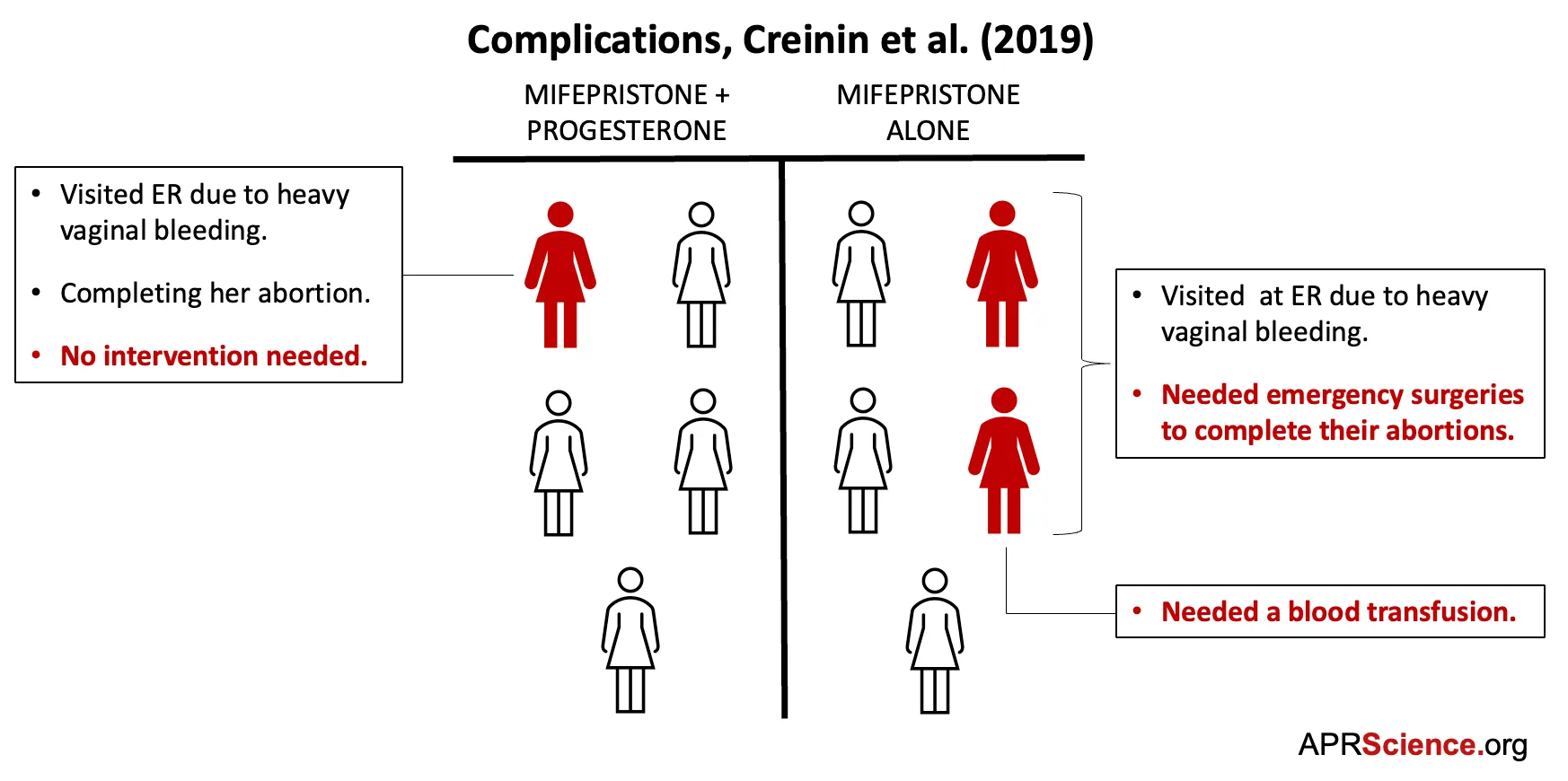
Dr. Turner challenges a claim by Stifani and Lavelanet that clinicians “should be cautious about providing high-dose progesterone off-label given the lack of evidence of benefit and the potential safety concerns.”2 Stifani and Lavelanet base their conclusion on a small randomized clinical trial (N=12) by Dr. Mitchell Creinin.3 Dr. Turner explains why the claim is misleading.
Further, the only women needing medical intervention in the Creinin study were the women who received mifepristone and placebo. The women who received mifepristone and progesterone did not require any medical treatment. Refer to the figure below and /is-apr-therapy-unsafe-for-women/ for additional analysis of the Creinin study.
Downplaying the Demand for APR Therapy
Many articles cite 0.004% as the percentage of women who change their minds after taking mifepristone. The original source of this number is from an article published by Daniel Grossman et al.4 and is based on personal communication with the drug distributor. Dr. Turner explains why this number understates that actual demand for APR therapy.5
False Statements Regarding APR Informed Consent
A 2023 article by Sara Redd et al. claims that ‘all published abortion reversal case reports demonstrated a failure to obtain consent from the women involved.“6 Turner demonstrates why this statement is not correct.
Citation
Turner, Joseph Vernon. 2024. Challenging Misleading Information about ‘Abortion Reversal.’ BMJ Sexual & Reproductive Health, June. https://doi.org/10.1136/bmjsrh-2023-202189.
References
Footnotes
-
Turner, Joseph Vernon. 2024. Challenging Misleading Information about ‘Abortion Reversal.’ BMJ Sexual & Reproductive Health, June. https://doi.org/10.1136/bmjsrh-2023-202189. ↩
-
Stifani, Bianca Maria, and Antonella Francheska Lavelanet. 2023. Reversal of Medication Abortion with Progesterone: A Systematic Review. BMJ Sexual & Reproductive Health, October, bmjsrh-2023-201875. https://doi.org/10.1136/bmjsrh-2023-201875. ↩
-
Creinin, Mitchell D., and Melissa J. Chen. 2019. Mifepristone Antagonization Requires Real Studies to Evaluate Safety and Efficacy. Contraception 100, no. 6: 427–29. https://doi.org/10.1016/j.contraception.2019.10.016. ↩
-
Grossman Daniel, White Kari, Harris Lisa, Reeves Matthew, Blumenthal Paul D., Winikoff Beverly, Grimes David A. 2015. Continuing Pregnancy After Mifepristone and ‘Reversal’ of First-Trimester Medical Abortion: A Systematic Review. Contraception 92 (3): 206‐211. https://pubmed.ncbi.nlm.nih.gov/26057457/. ↩
-
Garratt Deborah, Turner Joseph V. 2017. Progesterone for Preventing Pregnancy Termination After Initiation of Medical Abortion with Mifepristone. The European Journal of Contraception & Reproductive Health Care 22 (6): 472‐475. https://doi.org/10.1080/13625187.2017.1412424. ↩
-
Redd, Sara K., Roula AbiSamra, Sarah C. Blake, Kelli A. Komro, Rachel Neal, Whitney S. Rice, and Kelli S. Hall. 2023. Medication Abortion ‘Reversal’ Laws: How Unsound Science Paved the Way for Dangerous Abortion Policy. American Journal of Public Health 113 (2): 202–12. https://doi.org/10.2105/AJPH.2022.307140. ↩