
Providing Access to APR Data, Science, and Research
About APR Therapy
APR therapy involves giving the mother progesterone after taking mifepristone. APR increases progesterone concentration levels to better compete with mifepristone and restore a normal pregnancy.
Women seeking access to APR therapy should visit Abortion Pill Reversal.
Physicians seeking to join the APR medical network should visit APRN Worldwide.
Medical Evidence Summary
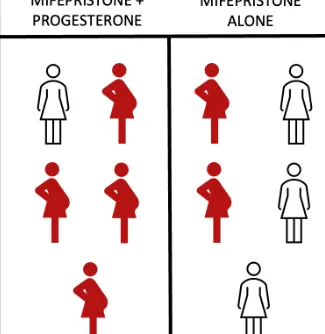
Since 2012, three case series (Delgado 2012; Garratt 2017; Delgado 2018), a randomized controlled trial (Creinin 2020), and a single-arm clinical trial (Turner 2023) have studied APR therapy in humans. The three case series investigated various progesterone dosing regimens and delivery methods (e.g., intramuscular, oral). The research shows that two-thirds (66%) of women who change their minds and receive progesterone after starting medication abortion with mifepristone can safely continue their pregnancies.
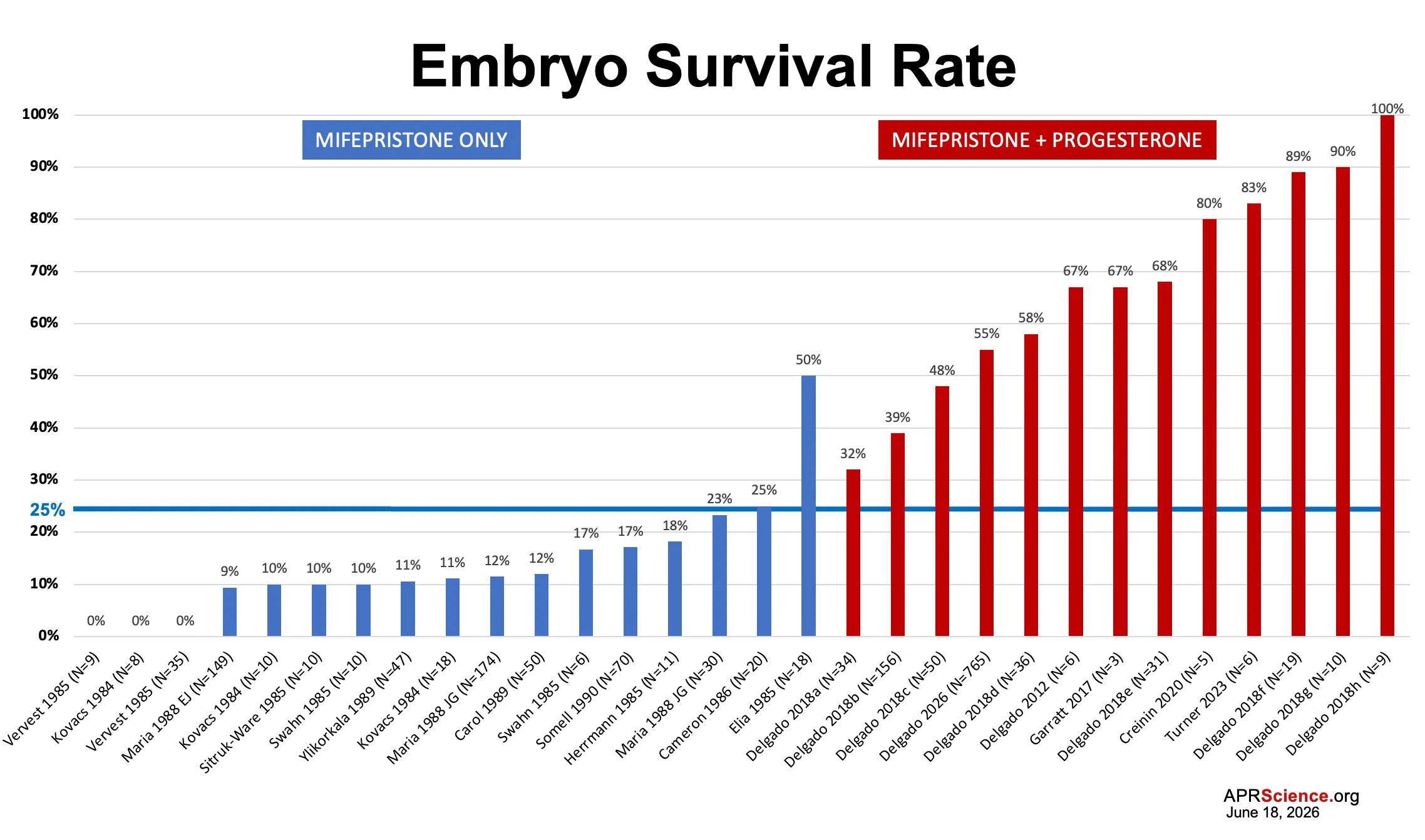


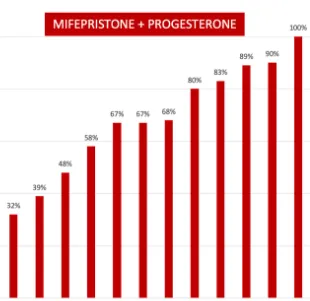
Embryo Survival Rate After Mifepristone and Progesterone
The chart above presents results from 17 mifepristone-alone studies (in blue) and from 12 mifepristone+progesterone studies (in red). Each of the studies used ultrasound to confirm embryo survival. The vertical axis shows the embryo survival rate, also known as the continuing pregnancy rate (CPR), reported by each study broken down by dosing and delivery regime. For instance, Delgado 2018e shows the CPR for oral administration of micronized progesterone. The results show that the embryo survival rate for mifepristone followed by progesterone is substantially higher than for mifepristone alone. Refer to dataset 1 for mifepristone-only details and to dataset 2 for mifepristone+progesterone details.
Read the questions and answers below to learn about APR science.
What is medication abortion and its drug regimen?
The most common medication abortion regimen uses two drugs, mifepristone, and misoprostol. Mifepristone is a progesterone antagonist. Misoprostol triggers uterine contractions, expelling the embryo.
Learn More about What is medication abortion and its drug regimen?Can a medication abortion be reversed?
Clinicians can stop the effects of mifepristone by increasing progesterone concentration. The progesterone outcompetes mifepristone for the binding sites on the progesterone receptors.
Learn More about Can a medication abortion be reversed?Is APR therapy safe for women?
The American Society for Reproductive Medicine reports no increased risk from using progesterone in early pregnancy. Physicians have safely used progesterone in reproductive medicine since the late 1970's.
Learn More about Is APR therapy safe for women?What are the three outcomes after mifepristone ingestion?
Complete abortion (embryo demise, uterine evacuation), incomplete abortion (embryo demise, no/incomplete uterine evacuation), or continuing pregnancy (embryo survival).
Learn More about What are the three outcomes after mifepristone ingestion?What is the continuing pregnancy rate after mifepristone alone?
Evidence from five studies since 2015 shows that the continuing pregnancy rate after ingesting mifepristone alone is generally below ≤25 percent for gestational age ≦49 days.
Learn More about What is the continuing pregnancy rate after mifepristone alone?What is the continuing pregnancy rate after APR treatment?
Evidence shows the continuing pregnancy rate after APR treatment is 65 percent or higher, well above the ≤25 percent continuing pregnancy rate for mifepristone alone.
Learn More about What is the continuing pregnancy rate after APR treatment?